Tuesday, July 28, 2015

Mining The Information Landscape: ATLA Annual Conference Denver June 17-21 2015 #Charleston #Emanuel9 #ActivistLibrarian


E. J. Josey speaking at a Conference circa 1970, The American Library Association Archives
I've been inspired by activist librarian E.J. Josey since I was first introduced to his work and legacy in library school at North Carolina Central University. I've incorporated this quote in almost every diversity program I've applied to since that time:

“It has been my professional goal to promote cultural diversity, not only in the profession of
librarianship and in libraries, but in American society as well.” ~Dr. E.J. Josey

I was compelled to embody the spirit of Dr. Josey at ATLA this year. Maybe FORCED is more appropriate. 

This post has taken me almost a month to write and I still don't feel up for the task. Therefore, this post won't be as comprehensive as it could've been had I not procrastinated so long. I don't really feel like retelling the story because since the Emanuel 9 Massacre, another mass shooting by a white supremacist has occurred, the Confederate Flag at the State Capital in South Carolina has been removed and at least 20 additional unarmed African Americans have been murdered by police in America. Surely, I'll be leaving a lot out to preserve the reputations of some of my colleagues. I am happy that ATLA is committed to working towards diversity and encouraged by the support of many #STAYWOKE theological librarians who clearly believe that #BLACKLIVESMATTER and diversity is not about numbers.

 I'll preface by saying the conference was great, however it was emotionally exhausting. I appreciate how receptive, timely and accommodating the ATLA Board of Directors were to myself and Jessica Bellemer's (Director of Library Services, Hood Theological Seminary) call to action. Special thank you's to ATLA President Beth Bidlack. Director of Library Services, Burke Library, Union Theological Seminary and Chris Anderson, Methodist Archivist, Director of Special Collections, Drew University. This post will be organized into three separate sections for clarity of narrative: Diversity Committee Pre-Conference Workshops, Emanuel 9 Board Response, and Self-Care.

Diversity Committee Pre-Conference Workshops

  • Back in January at our committee meeting we decided to hold a series of workshops and discussions about Racial Equity in Theological Librarianship at annual conference.
  • The day was divided into two learning environments: a morning session provided by The Denver Inclusiveness Project to help us better understand the value of inclusiveness and identify steps needed to create diversity, including training in the awareness of the impact of racism on institutions.
  • The afternoon session included a panel of ATLA members and guests who shared their personal experiences with racial equity issues and a discussion of how to address these issues in the context of theological librarianship
  • Both sessions were exceptional. There was rich, honest, vulnerable dialogue and a resolve among the small number of attendees to continue the conversation within the larger professional association and back home in there practices at home libraries. 
Handout Shared by Denver Inclusiveness Project 


One of the creative works circulating Tumblr within hours of the story hitting mainstream media
Emmanuel 9 Board Response
  • I checked my phone the evening of June 17th after a full day of diversity training to find Tumblr (the story was a bit slow to hit national news, social media is more and more showing itself to be the better tool for "breaking news") flooded with stories about 9 members of the Mother Emanuel A.M.E. Church in Charleston, South Carolina who had been shot to death by a young white man they welcomed into their usual evening Bible Study
  • The President of ATLA announced at the plenary session that 9 had been murdered at Mother Emanuel A.M.E. Church
  • The crowd of librarians, many holding tablets and smart devices GASPED. Audibly. LOUDLY. 
  • I was surprised and disappointed that so many hadn't heard. I understood we were a bit isolated by travel and attending the conference, but these we librarians, who I believed were responsible for being aware of what's going in the world (its part of the job description). 
  • After the session I ran into my mentor and Methodist librarian, Chris A. We commiserated together. 
  • I ran into fellow millennial and AMEZ librarian, Jess A. in the vendor hall. We came up with a plan of action. 
  • We organized a lunchtime chat at the hotel restaurant with the ATLA President and Director of Member Programs for those who wanted to talk about the tragedy. They graciously covered the meals of all attendees.
  • Quite a few members of the Board of directors attended and were extremely active in the conversation.
  • Jess and I worked throughout the afternoon to petition the Board to formulate an official response to the act of terrorism. Which I read aloud at the end of the Business Meeting. (see video below and resolution below) 
  • The Board convened. There were concerns raised and relayed from other members about where ATLA stood as far as politics, activism and diversity in relation to ALA. 
  • A proclamation was written and read at the ending plenary session.
  • Conversation continued after the conference via email among ATLA librarians via the ATLANTIS Listserv. Some of the responses made my stomach turn and hand shake, others (many sent directly to me off list) made me proud and optimistic about my membership in the organization and recent political act.   


We petition the board to convene to discuss an appropriate ongoing response for ATLA as an organization which builds upon the lunchtime discussion organized and attended by ATLA members about the religious and racial terrorism act, a dialogue that was inspired by the recent act which victimized the congregation at Mother Emmanuel AME Church’ in Charleston, SC, the victims of which ‘include alumni of ATLA member institutions and a professional librarian.
Whereas the board has been petitioned to make an appropriate ongoing response to the recent act of “religious and racial terrorism” that occurred at Mother Emanuel AME Church in Charleston, SC; and

Whereas this act occurred in a sacred religious space and impacted clergy, librarians, and their communities; and

Whereas the work of ATLA contributes to the formation of religious leaders and librarians; and

Whereas the victims included prominent leaders in the African American community; and

Whereas one victim (Cynthia Hurd) was an influential public librarian; and

Whereas two of the victims (The Rev. Clementa C. Pinckney and The Rev. Dr. Daniel L. Simmons, Sr.) were alumni of Lutheran Theological Southern Seminary, an ATLA institutional member; and

Whereas one of the victims (The Rev. Clementa Pinckney) was a D.Min. candidate at Wesley Theological Seminary, another ATLA institutional member; and

Whereas these tragic events directly speak counter to our core value of “Hospitality, inclusion, and diversity”;

Therefore be it resolved that we the board condemn this act of racially motivated violence that emerged out of a larger environment of social injustice;

Be it further resolved that the board commend its members for leading this discussion;

Be it further resolved that the board encourage continued member input into how to live into our core value and contribute to a change in the larger social environment;

Be it further resolved that the board encourages members to make appropriate resources available to their communities; and

Be it further resolved that the board expresses its grief and its solidarity with those affected by this tragedy.
  • After returning to Ohio and reading the responses of my colleagues on our ATLANTIS listserv I sent out the following email about the #Charlestonsyllabus shared by a Society of American Archivists Archives and Archivists of Color Roundtable:  
Greetings Fellow ATLA Colleagues,

Following up on our post Annual Conference ATLANTIS Listserv conversations and Board’s encouragement that we “make appropriate resources available to [our] communities”, I am sharing this incredible guide created by the African American Intellectual History Society #CharlestonSyllabus

Here is a list of readings that educators can use to broach conversations in the classroom about the horrendous events that unfolded in Charleston, South Carolina on the evening of June 17, 2015. These readings provide valuable information about the history of racial violence in this country and contextualize the history of race relations in South Carolina and the United States in general. They also offer insights on race, racial identities, global white supremacy and black resistance. All readings are arranged by date of publication. This list is not meant to be exhaustive–you will find omissions. Please check out #Charlestonsyllabus and the Goodreads List for additional reading suggestions.

http://aaihs.org/resources/charlestonsyllabus/

Program given to Payne Theological Seminary by surviving ministerial staff member and Payne MDiv Student Rev. Michelle Frayer
Inside program
My apologies that Blogger won't let me rotate the image
Self-Care

  • I attended all the workshops on diversity during the conference and fantastic sessions on outreach in special collections, best practices for writing collection development policies and EBooks for small libraries. These workshops directly supported the work I would be doing in my new role as Director of Library Services at Payne Theological Seminary. 
  • Friday I decided I had enough and needed a real break from everything and everyone so I went out on the town, alone. 
  • My good friend librarian Katie who interned with me at the National Transportation Library is a native of Denver and directed me around the city via cellphone.
  • The wealth disparity is evident as soon as you walk downtown. There is a serious homelessness problem in the city. All throughout the week native Denver(ians?) were telling me about how expensive housing is (condos upwards of 200K). 
  • My impression of the city: A walkable, beautiful city with good food, eccentric people with a few obvious class issues. 
  • Here are pictures of what I did:
In War Memorial Park

View from the rail downtown 
I think those are buffaloes

Katie's Favorite Restaurant 

I Needed a Drink
Ate the El Jefe for Katie 
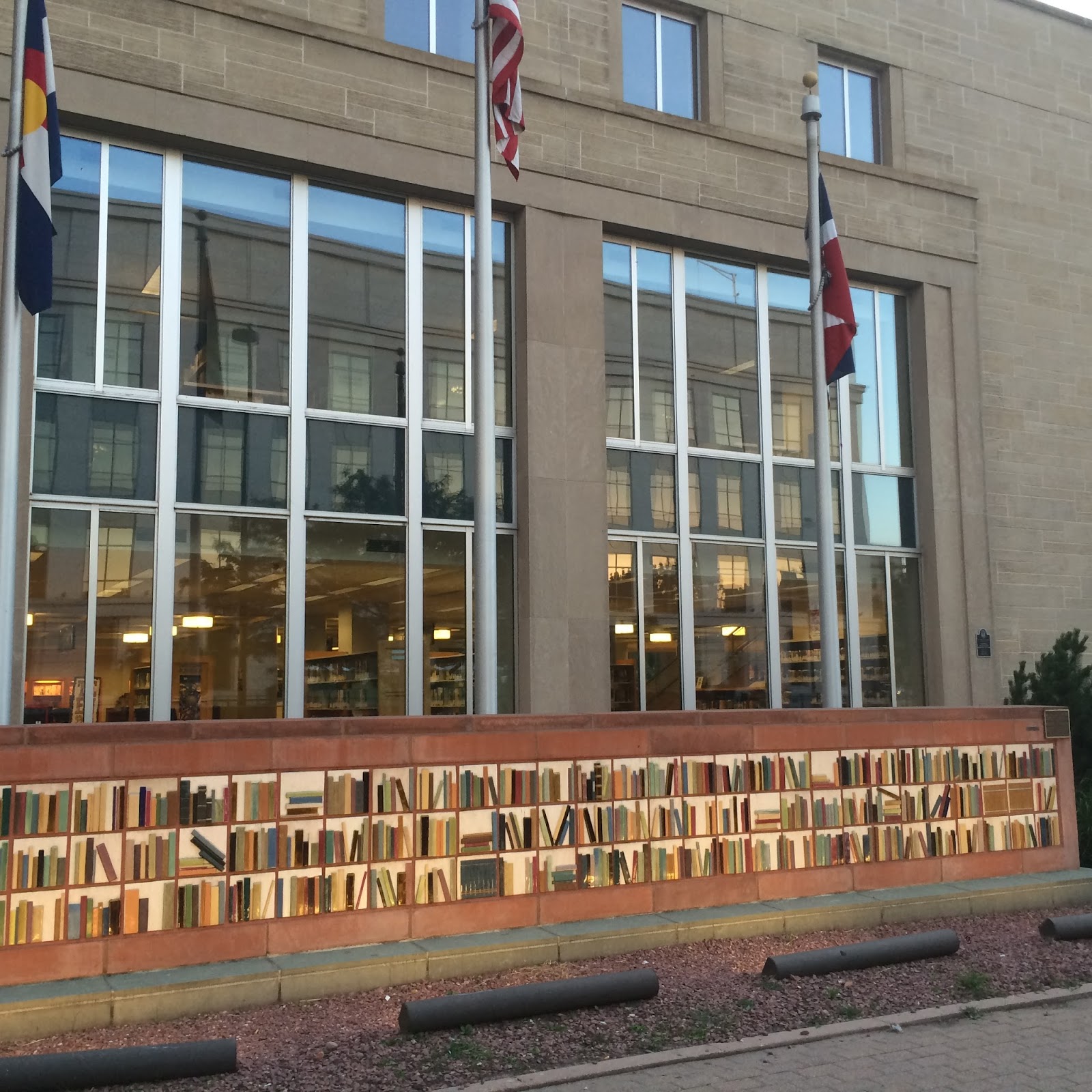
Denver Public Library
Coco-Rhina Beverage

El Jefe Burger with Curried Carrot Soup. The Curried Carrot Soup was BOMB. 


It was closed :( 
Interesting Advice on the Bathroom Door at City O' City


Friday, June 5, 2015

SCAIG Spring 2015 Workshop: Special but not Specialized: Special Collections and Archives Do it All at Kent State University

This 12 story building houses the library, archives and special collections along with a number of departments. The billboard announces "You Belong Here". Perfect!
On June 3, I drove 3.5 hours (each way) Northeast to Kent State University to attend the SCAIG Spring 2015 Workshop: Special but not Specialized: Special Collections and Archives Do it All. The overall theme/purpose was getting to know our special collections and archives colleagues from around the state and hold conversations about the most pressing issues affecting our work. The informal presentations "Reference and Instruction", "Let Them Build It: Working with Students to Curate Digital Exhibits" and "Problems? What Problems? Attitude is Everything for Lone Arrangers" were extremely encouraging and insightful. I learned great strategies for getting faculty "buy-in" for including digital objects and archives in their courses, how to match assessment to learning outcomes, ideas for designing the library page at Payne, how to use social media effectively to share our collections, and development events that benefit the entire institution (Business Card Exchanges and Alumni Library Sponsorship).

One new cool feature of the workshop were the World Cafe Style Conversations. I brainstormed with colleagues about Instruction/Assessment, Outreach, and Preservation/Digitization/Born Digital/Technology.

I also had the opportunity to spend lunch with a 2 colleagues who presented at SOA about their archival move a few weeks ago and ended up sitting with two other NC Library School alums at lunch (North Carolina State and UNC-Chapel Hill). Small World!

One word: BABAR. Imagine walking to room bursting with color and whimsy and BABAR. It's available and within reach.

Kent State is home to the one-of-a-kind collection, bequeathed to Kent State University in 1992 by John L. Boonshaft of Las Vegas, Nevada, containing books and artifacts relating to Babar, the fictional elephant created by Jean de Brunhoff in 1931 and perpetuated by his son, Laurent, after Jean died in 1937.

 But honestly, the very best part of the conference was connecting with La'el Hughes-Watkins, University Archivist, Assistant Professor, Kent State University Libraries. After touring The Kent State Shootings and Their Aftermath" Through The Media's Lens exhibit curated by La'el we chatted about our paths to archives and what it meant to be women of color in administrative positions in the library world. We were encouraged by one another's journey's and made fast friends (even attending RibFest in a few weeks!). I was fascinated to learn how La'el pulled from her background in journalism to curate the Through The Media's Lens chronological exhibit which highlights some of the major newspaper headlines, magazines, photographs, newsletters, posters, flyers and comic strips produced in light of the Kent State Shootings. The exhibit and meeting her alone were worth the 7 hour road trip. Check out the pics from this wonderful day:

Me and Rockwell "Rocky" K. Squirrel, University Libraries Official Spokes-squirrel (who has his own business cards)

Through the Lens

I love how the exhibit "bleed" into the hallway outside the reading room where the exhibit is house. These display cases are exceptional!


Life sized BABAR!
They even made Babar labels!

Huge in house scanner for library signage and other paper production. I wish!

In the archives stacks 
Two Dynamic Overachieving Archivists making our mark in the field

Tuesday, June 2, 2015

Society of Ohio Archivists Annual Meeting and The New Professionals Award


On April 2, 2015, The Society of Ohio Archivists (SOA) announced the names of scholarship recipients for the “2015 SOA Merit Awards, New Professional Scholarships, and Student Scholarships to the SOA Annual Meeting Competition”. I was awarded the new archival professionals award. As a new transplant to the Miami Valley Area from Durham, I had limited knowledge of the Ohio landscape. Attending a variety of conferences as a student intern and employee in North Carolina gave me a great lay of the land and connected me with organizations with whom to collaborate. I applied for the scholarship on account of the opportunity for networking with Ohio repositories and build strong relationships with OhioLink, OPAL Consortium, local public libraries, museums and historical institutions, and the African Methodist Episcopal Church.

Receiving my award from SOA President Judith Wiener
The scholarship for archival professionals with three years or less experience in the workplace will provide funding to attend the associations’ annual spring meeting on Friday, May 15, 2015 at the OCLC Conference Center in Dublin, Ohio. The scholarship consists of conference registration (including lunch), a one year membership to SOA, and a $100 travel stipend. Awardees are required to write about their experience for publication in the Ohio Archivist newsletter.

Here goes:

I carpooled with the Greene County Archive crew to Dublin for the Archives Amplified themed meeting. In addition to hearing about the Billy Ireland Cartoon Library and Museum at The Ohio State University from Jenny Robb, Curator and Associate Professor, I attended the following sessions, "Delivering the Ohio Department of Health and Death Certificates Digitally", "The Value-Added Archivist: Becoming an Integrated Part of the Academy", "Creating Digital Stories and History Harvests for Outreach and Instruction", and "Out of Site: Coordinating a Large-Scale Move of Archival Materials".

All of the sessions were great but I was most intrigued by the Value-Added Archivist presentation in which the flipped classroom model was highlighted. We were challenged to think about creating a strategy for archives integration into the curriculum, determining research and teaching needs (not digitizing for digitizing sake, and defining the first steps in creating assignments for sustainable projects.

As the adolescent who spent way too much time on Ancestry.com when the site first launched I was fascinated by the Health and Death Certificates presentation. The Ohio History Connection provides access to 2,000,000 digitized 1954-1963 Ohio Department of Health and Death certificates for patrons to research. The presenters shared Orville Wright's death certificate with us and explained how they created an online index and email system for sending PNG copies of certificates to patrons for a $7 a pop.

The first thing I noticed about the SOA membership much like ATLA is that it is small and everyone knows one another, therefore it is fairly easy to get involved in committees and approach colleagues about tangible collaborations. I volunteered to serve on the Advocacy Committee.


Dreamy

General Session Room
View of the OCLC Building from the 2nd floor where look was served

Take 2
The Merit Award and Scholarship Recipients 


Monday, June 1, 2015

The Payne Theological Seminary and A.M.E. Church Digital Archive is LIVE!

The history of Payne Theological Seminary, one of the nation’s oldest African American seminaries is now at your fingertips, thanks to a collaboration between Payne and Princeton Theological Seminary.

With funding from the Arthur Vining Davis Foundation, Payne Theological Seminary is actively digitizing materials from its historical archives and contributing the digitized versions to the Theological Commons. The collection will contain curated, contextualized subcollections of images and textual materials for the study of the history of the African Methodist Episcopal (A.M.E) denomination and Black Church tradition while chronicling the leadership and legacy of Payne Theological Seminary.

The records available for research include blueprints, handwritten manuscripts, rare books, bulletins and photos that date back to the 1800s which document the establishment of the Black Church in America to the physical changes and developments of a number of African Methodist Episcopal Educational Institutions.


This unique digital archive is publicly accessible at http://commons.ptsem.edu/payne

Friday, May 29, 2015

Payne Theological Seminary 2015 Commencement: Processing with the Faculty

Selfie with Dean Michael J. Brown, new Interim President
Momma I made it! 
A Great Shot taken by my Colleague, Dr. Betty Holley
I was humbled and excited by the invitation of the Dean and members of the faculty to process for the first time at the 2015 Commencement Ceremony. It was my first time donning the lemon yellow hood for Library Science as I chose not to attend my MLS graduation exercises. After a hurried purchase from Herf Jones Express, I was happy to add the unique coloring of the MLS regalia (it would have been in poor fashion to don the MDiv hood at the same time) to the processional and advocate for the role of the library in theological education.

The commencement address was delivered by Cornell Williams Brooks, Esquire, President and CEO  of the NAACP. His message to the seniors was superb. I especially enjoyed his interpretation of the conversation between Esther and Mordecai in Esther 4:16 and his call for the senior class to go forward in their ministries with Esther's gumption, "And if I perish, I perish".

Honorary Doctor of Humane Letters were awarded to Cornell William Brooks, Esquire, Dr. Gayraud Wilmore, Distinguished African American Theologian and Scholar, and Mrs. Vivienne Anderson, retired Episcopal Supervisor and widow to the former beloved Chairman of the Board at Payne Seminary, Bishop Vinton R. Anderson.

In addition to being delighted by the joy and thankfulness expressed by the seniors as I overheard their prayers and shouts just over my shoulder, the 18 members of the graduating class also nearly knocked my heels off with their pledge to purchase new computers for the library! The senior gift will give me the leverage to order a KIC Scanner machine and implement a printing system in the library for student use.

Speaking of library use, the Bishop Reverdy C. Ransom Library was packed out for the 5th Annual Bishop Vinton R. Anderson Ecumenical Institute on The Life and Work of the Late Bishop Vinton R. Anderson and His Impact on the Legacy on the Ecumenical Movement on May 20th as part of Commencement Week Activities. The keynote was Dr. Gayraud Wilmore, Internationally acclaimed scholar and theologian of the history of the African-American church and black theology, The lecture respondents were Rev. Dr. Louis-Charles Harvey, Presiding Elder of the Potomac District, Washington Annual Conference and  Mr. John Thomas III, Coordinator of Youth and Young Adults for the World Methodist Council.

We had not had an opportunity to see how the library functioned as large public meeting space until the lecture. Professors and students regularly use the library's two group meeting rooms for class and intensives but the open meeting area just in front the stacks normally doesn't get much play. It was extremely fulfilling to see the space filled and hear lecture guests gushing over how complimentary the library was to the "feel" of the event due to Bishop Anderson's work to get the library built in 2009. I will absolutely be working on public programming to bring more people (Friends of Payne, Wilberforce University Students and community groups) into the space. In my development of a library and archives policy I created a meeting space policy and form (more on writing policies and procedures in another post).
Dr. Wilmore
Packed House!!!
Dr. Harvey

From Wilberforce to the World Council of Churches: Curating the Bishop Vinton R. Anderson Exhibit


When I was being interviewed for the gig here at Payne, I was told that I would have an exclusive opportunity to curate the personal collection of Bishop Vinton Randolp Anderson, deceased A.M.E. bishop and president of the World Council of Churches. The best part of that opportunity for me was hearing that his robes would be gifted to the seminary and prominent displayed in an exhibit on site. I was all in.

In preparation for Commencement Week I was charged with curating a small exhibit on the life of Bishop Anderson using what "artifacts" were already available in the archive (aside from his robe personal materials had not yet been donated). There wasn't much to work with, so I got creative. A display case was moved from the administration building over the Mitchell-Anderson Building where the display would be located within the Bishop Vinton R. Anderson Ecumenical Institute.

After re-reading Bishop Anderson's bio I thought about documenting his path as a student of Wilberforce University and Payne. This part was fairly easy, Wilberforce yearbooks and Payne catalogs were in abundance between our two institutions (shout out Mrs. Brown, Wilberforce Archivist!). Next I thought about his candidacy and run for Bishop and naturally looked to the boxes of the Christian Recorder on our shelves. Below is the panel text I created for the display along with pictures. I really really really enjoy exhibit design and didn't realize how much I missed curating displays since leaving the Duke Divinity School Library.


The Legacy of Bishop Vinton Randolph Anderson at Payne Theological Seminary

Bishop Anderson, elected to the episcopacy in 1972, was a distinguished pastor, writer, ecumenist, liturgist and leader in African Methodism and throughout the world.

The exhibit, "From Wilberforce to the World Council of Churches," recounts Anderson’s early academic career, campaign for the episcopacy, ecumenical involvements and chronicles his continued contributions to the administration, campus construction and growth of Payne Theological Seminary.
 An elected and consecrated African Methodist Episcopal Bishop, Anderson was actively involved in ecumenical affairs, serving as President of the World Council of Churches from 1991-1998, leading over 560 million members and 330 denominations in interfaith dialogue and collaboration. During his distinguished two decade tenure as Chairman of the Board at Payne, Bishop Anderson was committed to renovating the Mitchell-Anderson Building and at the forefront of the effort to build the Bishop Reverdy Cassius Ransom Memorial Library. His witness for ecumenism in theological education led to the founding of The Bishop Vinton R. Anderson Ecumenical Institute at Payne in 2011. The Institute promotes programs of education, advocacy, and service that address critically important social needs and offers opportunity for the Church to witness through common faith expressions developed from the ministry of Jesus Christ.

Bishop Anderson migrated from Bermuda where he was born in Somerset, on July 11, 1927 to the United States in 1947 at twenty years old to attend Wilberforce University where he went on to earn a Bachelor of Arts with Honors. Anderson strengthened his religious knowledge as he gained his Masters of Divinity from Payne Theological Seminary in 1952. As seen in the Wilberforce University Forcean Yearbooks on display, Bishop Anderson was a member of the joint choral group the Payne Singers from 1948-1951.

The robe on display is a gift from Mrs. Vivienne L. Anderson, wife of Bishop Vinton R. Anderson. Embroidered in gold lettering inside the robe is the text “Robes of Faith for Bishop Vinton Anderson (AME Church Crest) 1972”.  Robes of Faith, Inc. was selected to design and create the exclusive Vestments worn by the Bishops of the AME Church worn by the Presiding Elders and the General Officers of the AMEC. The color purple marks and defines the ceremony and protocol of the church. Purple symbolizes Authority & Kingship (Judges 8:26) Wealth (Acts 16:14 & Proverbs 31:22) Royalty (Esther 8:15) and is also the liturgical color for Seasons of Advent and Lent.
Along with photographs of Bishop Anderson and Mrs. Anderson at the November 13, 2008 tribute celebrating his legacy and leadership as Chairman of the Board, Bishop Anderson speaking at past Founder’s Day events and the installation of Dr. Leah Fitchue as President of Payne Theological Seminary, four original copies of The Christian Recorder featuring articles about his road to the episcopacy are also featured.

Exhibit design and display: ShaneƩ Yvette Murrain, Seminary Archivist
Gifts: Robe, Vivienne L. Anderson, 2014
Loans: 3 yearbooks, Wilberforce University Archives 2015

Dr. Fitchue, Bishop McKinley Young and the Anderson Family viewing the display

The Development Team shared Bishop's enthusiasm, this picture is good evidence


Wednesday, May 13, 2015

Mother's Day Brunch at the Dayton Art Institute and Dayton Aviation Heritage National Historical Park

Joy and I with the talking store clerk robot ($)
One of the primary reasons I accepted the archivist position at Payne in January was the opportunity it afforded me to work with local cultural heritage organizations. Since moving to Ohio, I've quickly learned that Wilberforce has a small but extremely rich community of historians who are passionate about the preservation of African American History.
I met Joy G. Kinard, Ph.D. Superintendent, Colonel Charles Young Buffalo Soldiers National Monument while attending the Colonel Charles Young Birthday Commemoration at the National Afro American Museum. We spent Mother's Day attending service at my home church, touring the Dayton Aviation Heritage National Historical Park where her office is located and dining on delectable candied bacon at the Dayton Art Institute's Annual Mother Day's Brunch.


Dayton Aviation Heritage NHP consists of five sites that tell the stories of Wilbur Wright, Orville Wright, and Paul Laurence Dunbar. Coming from North Carolina I was just certain that all that the Wright Brother's history was the legacy of the Tarheel state. Clearly I was misinformed. While walking through the Wright-Dunbar Intrepretive Center, I learned that the Wright Brother's built their aircraft in Ohio where they were born, raised, owned multiple non-aviation related businesses (bicycles!) and died, but traveled to North Carolina to launch due to the favorable humidity and flying weather. The Raleigh-Durham International Airport and all those First In Flight NC license plates are a bit deceptive. Glad I now know the truth!

I'm making it my business to visit the Paul Laurence Dunbar State Memorial  in the next few weeks. I remember first reading Dunbar's poem We Wear the Mask in 5th grade. I don't recall the context in which it was taught but I remember being confused yet deeply comforted by the imagery of the pain in pretending.


Joy considering the offerings in the replica 3rd Street Market Exhibit 


The Bacon. My God!

The Dayton Art Institute knows how to throw a good brunch!