Wednesday, May 13, 2015

Greene County Records Center and Archives and "The Book of Negroes"

On March 30, I visited the Greene County Records and Archives in Xenia, Ohio to tour the facility, meet with archivist, Robin Heise and look up some of the early deed records for Payne Theological Seminary and Wilberforce University.

According to the dates I shared with Robin, the Articles of Incorporation 1894 should have been the jackpot for us, unfortunately there was no record. All the Greene County staff was able to find were deeds for Wilberforce purchasing various lots of land.  It didn't appear that any of the deeds that are attached, have anything to do with Payne Theological Seminary.

Holding the Emancipation of Free Blacks 1805-1845
Though my quest for original deed records for Payne were fruitless, Robin shared an amazing document that is top five on my list of "Most Amazing Things I've Ever Held". I asked Robin what her favorite record in the archive was and her eyes lit up like a Christmas Tree. She opened up one of the compact shelves behind us in the clerk of courts room and carefully unboxed a nondescript blue hardcover book. She placed it carefully on the table and let me read the cover, The Greene County Clerk of Courts Emancipation Record of Free Blacks 1805-1845. Absolutely incredible! Within the first few pages I read the handwritten names, ages, physical descriptions, places of origin, and anecdotal accounts of Free Blacks who found a home in Ohio (Ohio was admitted into the union as a free state in 1803). As I read a short paragraph about a young boy around the age of 8 named John, I immediately thought of the BET miniseries The Book of Negroes that I binge watched the previous weekend. 

The Book of Negroes is a miniseries based on the novel of the same name by Lawrence Hill. The six-part miniseries derives its origins from the historical document Book of Negroes and tells the story of a woman forcefully brought to South Carolina from West Africa at the time of the American Revolution. Clement Virgo and Hill collaborated on writing the miniseries, with Virgo also directing. It premiered on BET in the United States on February 16, 2015.

The main character Aminata Diallo is recruited by Sir John Clarkson to help register names of Black British Loyalists in a ledger known as The Book of Negroes, granting them freedom and passage to Nova Scotia. Aminata is an archivist, a keeper of the record. In the one of the final episodes of the miniseries we see Aminata reunite with a baby she delivered (she was trained in midwifery by her mother prior to capture, a profession which sustained her and offered special privileges throughout servitude) as she is taking names and stories in the book. The presidential theme of Society of American Archivist Kathleen Roe is "Year of Living Dangerously for Archives." Archivists across the world were challenged by Roe via social media to think about why we are archivists. Colleen McFarland Rademaker's reflection resonates deeply with me as I think of Aminata and the Emancipation of Free Blacks 1805-1845, "I am an archivist because I love facilitating relationships across time, between the living and the dead. I find archival work to be deeply spiritual because of the sense of connectedness that permeates the archives." 

In addition to the Emancipation of Free Blacks 1805-1845, following records are available for research at the Greene County Archives: Tax Records 1806-1930, Common Pleas Court Records 1804-1957, Naturalizations (incomplete) 1822-1958, Engineer Maps, 1870-1970, Survey Records, 1792-1995, Birth/Deaths, 1869-1909, Marriages, 1803-2009, Wills and Estate Cases, 1803-1997


Combing carefully through the Emancipation of Free Blacks

Every Ohio Archive has a propeller or some other assorted plane part...if not a whole plane. 
1894 Deed of Records
Greene County Map

Grant Writing and Archival Management Software: Ohio Historical Records Advisory Board Grant Award 2015

I wrote a grant proposal. I wrote a grant proposal within the first two months of becoming Seminary Archivist at Payne. It was fully funded.

On March 13, 2015, the Archives at Payne Theological Seminary was notified that the Arrangement and Description of the Payne African Methodist Episcopal Church Archive proposal submitted to the Ohio Historical Records Advisory Board (OHRAB) through a grant from the National Historical Publications and Records Commission (NHPRC) was one of 20 applications fully funded. The project will focus on processing two special collections: the Bishop Reverdy C. Ransom and George A. Singleton Collection. Grant monies will go towards the purchase of Proficio Elements archival management software and preservation measures to facilitate future use by researchers without further damage.

This project will focus on two special collections: the Bishop Reverdy C. Ransom and the George A. Singleton Collections. The materials provides a rich resource for African American research and are the most accessible collections for current research use due to their organization and good physical condition. The Ransom collection is fascinating in that it chronicles the life and ministry of Bishop Ransom (1924-1952) and also shares details of Payne Theological Seminary and Wilberforce University during their struggles to remain institutions of higher learning during the 1940’s.

Both collections were unprocessed and unorganized prior to the construction of the archive facility in 2009, but were rehoused in 2013, when a number of Payne graduate student interns from the Payne Theological Seminary students with no formal training in archives and records management inventoried them. This was done as part of a concerted effort to put the archive in some recognizable order, facilitate a future intellectual assessment, and provide immediate access to researchers. Some of the material was foldered and standard preservation measures were taken. Since several of the Ransom letters were deteriorating, many were placed in Mylar sleeves to facilitate future use by researchers without further damage. The remainder of the collection was processed according to a basic‐level processing guidelines: materials were placed in half-Hollinger boxes, arrangement work within individual folders is not complete, and fasteners have not been removed collection materials.

My rationale for purchasing the software follows:

As our investment in the institutional archive– specifically, the Payne Theological Seminary and A.M. E. Church Digital Archive– grows, I anticipate increased use of the collections by scholars, students and the community and believe it is crucial to have an item level knowledge of the PTS archival holdings.

I propose we purchase the Proficio Elements Software from Re: discovery for managing museum and library collections as I think it will allow us to have an accurate account of the extent of our collection and help ensure that we can answer user research requests.


After consulting with Paul Daniels, Head of Arts and Archives, Luther Seminary, Christopher Poet, Archivist, Bishop Payne Library, Virginia Theological Seminary, PTS' in house IT specialist, and participating in an hour long webinar demonstration of the software, I think Proficio Elements is the best choice for Payne. With this choice Payne skips the prohibitive costs and tech support specifications of many collection development systems. Proficio allows us to manage and catalog our collection, create digital images, online records and finding aids and also run reports.

With Re: discovery Payne can update to the full Proficio at a later date should our needs change as the collection grows to include a variety of artifacts and digital formats. The software also includes a module for the library. That way, Payne can keep things simple with a single, comprehensive knowledge management system for our entire library program.

OHRAB’s regrant funding program is supported by funds obtained from the National Historical Publications and Records Commission (NHPRC). Through OHRAB’s regrant application process, funding is provided to institutions and local groups to assist in the preservation of archives and historic collections.

http://www.payne.edu/files/2733/File/NEWS%20RELEASE%20-OHRAB%20Grant--.pdf

Friday, February 27, 2015

1-900 Hustler and Networking: Wright State University Libraries Special Collections and Archives

 Everyone networks. Networking is the linking together of individuals of mutual interest. Through trust and relationship building, contacts can ultimately become walking, talking endorsements for one another.

I was an eight grader, years away from having to do any professional networking when Jay-Z dropped his fifth studio album The Dynasty: Roc La Familia in 2000. One of my favorite songs on that album from first listen is and will always be "1-900 Hustler". In the tune Jay-Z serves as an Ask Annie of sorts for drug dealers calling in with questions about establishing clientele in a new town, getting a swift dispersal of advance money from their record label, and discussing illicit activity over recorded phone lines without getting anyone indicted.

In the first verse Beanie Sigel fields a question from a young man in who is the only Brooklynite in a new area who is looking to set up his cocaine enterprise in the area. Jay-Z shares the following tips and tricks:

"Here's a couple of suggestions of how you could finesse it
You find a dude in town, you send him a short message
Say, "Hey, I'm new in town, I don't know my way around
But I got some soft white that's sure to come back brown
I get that butter all night
'Cause most (word redacted) don't know a brick from a bike
They keep buyin' hard white
And if you free tomorrow night we can meet and discuss price
FYI, I never been robbed in my life"

Read more: Jay-Z - 1-900-hustler Lyrics | MetroLyrics

Though I'm a theologian librarian in real life, I move in my mind like a hustler. I am new in the Dayton area and know the value of being connected. I didn't have any unprocessed cocaine to peddle when I reached out to the Head of Special Collections at Wright State University but that did not stop me from sending a "short message" introducing myself and requesting a meet and greet to discuss opportunities for field study placements for Public History students at the Payne Seminary Archive. In this transactional meeting I learned the Head and I shared a Duke colleague and walked away with a wealth of information about the Public History program, historic preservation and archives events in the Dayton area, resources for archives architecture, upcoming professional development opportunities and a few new archivist colleagues to be in touch with.
The Special Collections and Archives located in the Paul Laurence Dunbar Library collects, preserves, and makes available the history of aviation, the local and regional history of the Miami Valley of Ohio, and the university's history. Along with diaries, letters and oral histories documenting the human experience from the ordinary life of an Ohio farm wife to Dayton survivors of the Holocaust, the collection includes: The largest Wright brothers collection in the world, A Cold War aerospace technology archive, Papers of political figures and parties, The Dayton Daily News newspaper archive, local government records, Records of major arts organizations, Collection of Paul Laurence Dunbar first editions, Women's history collections, Letters, diaries, and photographs of the first families of Dayton, Records of civic and community organizations and associations, Religious history collections, The Wright State University Archives.

Here are some pictures from my February 26 visit:

Collections on the left, Offices on the right
Me and the Guys
Model Airplane in the Library

Wright Brothers Vault
Office decor
Original Flight log from 1912 Wright Brothers Flights
Yours truly holding an original print from the glass print negative December 17, 1903 first powered controlled flight by the Wright Brothers
Wrights Brother medals 
 
Wright Brothers Medals and Papers


Monday, February 16, 2015

Motivation and Eating An Elephant

 There's an old wise joke that goes: How do you eat an elephant? One bite at a time.

 After expressing frustration about deciding how to create measurable goals for my processing work, identifying what daily success looks like, and dealing with a bit of legacy library mismanagement (if they'd known better, they'd done better), my mentor encouraged me to find a photo from the archives to identify with. She encouraged me to let it be my motivator. I was to locate a photo that represents perseverance, opportunity, and education.

I didn't have to look far. My first week at Payne I stumbled upon the photo below in a box of unorganized photos and miscellaneous oversized objects in the Singleton Collection (which is proving to be my favorite!) It is what I've found to be one of the greatest conversation pieces of the archive. Everyone I've shown it to has been wowed, Black, White, young, old. People remark at the mens' dress ("You don't see men dressed so well anymore!"), facial hair ("Look at those chops and sideburns!", "Everyone looks like Frederick Douglas!"), the age of the photo ("1868! Really?!!?"), and delight in pointing out which of the seated bishops they recognize. I made sure the photo was in the first batch of materials to be digitized at Princeton. I have prominently placed in the archive so it is the one of the first things visitors see when they approach the side desk and begin poking around.

Photograph Thirteenth General Conference of the African Methodist Episcopal Church Washington, D.C. May 4-21st 1868
What I love about the photo is often overlooked and goes unnoticed until I point it out. Do you see at the top frame of the photo, in the half moon window? Do you see the women? Dressed in black and white in what resemble habits with their mischievous and knowing grins? These women who "photo bombed" this all male documentation of history (securing a photographer and staging a shot are clearly evidence of a commitment to historical preservation!) are my real motivation. What were their roles at the conference? What did the church and its organization mean to them? What opportunities were they seeking after through their participation and presence? What was their motivation? Did they know how radical peeping out the window to ensure their likeness be captured was?

From the General Conference Proceedings, 1868 (in part) and Partial Proceedings of the General Conference Proceedings of 1868 found in appendix of the History of the African Methodist Episcopal Church 1856-1922 by Charles Spencer Smith (Philadelphia, Pa.:1922) Bishops Daniel A. Payne, William P. Quinn, Alexander W. Wayman, and Jabez P. Campbell presided. New chapters on the Book of Discipline and Book of Concern were introduced, a resolution admitting the Southern delegates to full membership, a report on the Freedman National Banks were some of the official business handled at this meeting. Of course there is no mention of the women.

 Now I have a list of workable goals by the week, month and day on my home fridge to remind me each morning of that I only have to put a bite of elephant on my fork each day and palpable motivation the for these tasks.

Identifying Photos and Striking Historical Gold: Quinn Chapel A.M.E. Church Lovejoy, Illinois

 
As the lone arranger at the Bishop Reverdy C. Ransom Library working in an unprocessed archive, a large amount of  my time is spent identifying materials and investigating their historical significance. An archivist's guiding assumption as she combs through a box or folder is "These items were preserved because some individual or group found them to be of inherent [historical] value." That inherent value is not always obvious or easy to apprehend. Aged, crumpled, black and white processing, yellowing edges, and sloppy script are good indicators to me that an item is definitely worth taking a deeper look at (hence why I spend hours on Google after reading one church bulletin falling further and further down the African American History rabbit hole....more tales to come).  Uncovering the who, what, where, and  sometimes why of an item is my favorite archival task.
 
Who: I  found 6 black and white photos of Quinn Chapel A.M.E. church in a folder of photos and letters dated around 1958 in the George A. Singleton Collection. The George A. Singleton Collection memorializes the life and career of African Methodist Episcopal Church educator and pastor, long time editor of the A.M.E. Church Review (1951-1967), elected editor of the denominational journal Christian Recorder (1936-1944), Dean of Turner Theological Seminary at Morris Brown College (1929-1930) and World War I 1st Lieutenant Army Chaplain (1918-1919) George Arnett Singleton. Singleton earned degrees from Allen University (B.A. 1915), Boston University (S.T.B 1922), and the University of Chicago (M.A. 1929, B.D. 1930). He also published numerous pamphlets and a comprehensive history of the AME Church, Romance of African Methodism: A Study of the African Methodist Episcopal Church.
 
What: The photos included shots of a beautiful wood double cross adorned church entry way, dedication stone and various views of the building.


Where: Here's where things get tricky. The dedication stone names the church as Quinn Chapel A.M.E. Church organize 1869, rebuilt 1870, Rev. E.O. Allen, Pastor. The back of the photos all have some variation of a script inscription noting the photos as belonging to the Singleton Collection, W.P. Quinn as the 1839 founder of the church, and an illegible town name before the word Illinois. The Quinn Chapel I had known to be the foundational church of the state of Illinois is located in Chicago. Neither myself nor Ms. Ayers (Payne Librarian) could make out the chicken scratch. So we pulled out the Encyclopedia of African Methodism. Conference proceedings and booklets from the Fourth Episcopal District (Indiana, Chicago, Illinois, Northwestern, Michigan and Ontario
Conferences) to find references to a Quinn Chapel outside of Chicago. After discovering that the scratch HAD to say "Lovejoy", we hopped on the Google dig and stroke gold.

Why: 
 
From Wikipedia:

"Brooklyn (popularly known as Lovejoy), is a village in St. Clair County, Illinois, United States. Located 2 miles north of East St. Louis, Illinois and 3 miles northeast of Downtown St. Louis, Missouri, it is the oldest town incorporated by African Americans in the United States. It was founded by freed and fugitive slaves from St. Louis, Missouri, led by "Mother" Priscilla Baltimore in the period of 1829 to 1839. Its motto is "Founded by Chance, Sustained by Courage". The current mayor is Mayor Vera Banks-Glasper. Superstar Tina Turner regularly performed at a local club in her early years as an entertainer.

 A missionary AME Church was established in the new settlement in 1836.Now known as Quinn's Chapel AME, its congregation is believed to have supported the Underground Railroad and aided fugitive slaves to freedom, together with members of the Antioch Baptist Church established in 1838.
 
William Paul Quinn, then a missionary of the newly formed African Methodist Episcopal Church (AME), visited the settlement in 1836 and helped found the Brooklyn AME church that year. He had been assigned as a missionary that year to what was then called the Northwest, including Indiana and Ohio. Quinn was also active in planting new congregations in Kentucky and Missouri; he later became the fourth bishop of the AME Church. Brooklyn AME Church is thought to be the first AME Church west of the Appalachian Mountains. It is now known as Quinn's Chapel AME Church in his honor.
 
(Brooklyn, Illinois. (n.d.) In Wikipedia, Retrieved February 16, 2015, from http://en.wikipedia.org/wiki/Brooklyn,_Illinois)

Since accurately identifying the church in the photos I have reached out the executive board of the Historical Society of Brooklyn, Illinois and contact person at the Brooklyn, Illinois Archaeology and Heritage Project with my interest in working together to find a more concrete history of the Quinn Chapel AME and its ties to the first African-American town to be incorporated. I also have plans to contact the church to invite all hands on deck to write a contextualization article to accompany the images.

More information about the Brooklyn, Illinois Archaeology and Heritage Project and Historical Society can be found here:
 

Wednesday, February 11, 2015

Archivists Connect: An Introductory Visit to the Wilberforce University Archives and Library


On February 9, 2015  President of Payne Theological Seminary, Librarian and Director of Development, and I took the short trek (really less than a mile away) over to our mother school to visit with Mrs. J. Brown who has coordinated and managed the archives at Wilberforce University for close to 47 years. The purpose of the meeting was to introduce me to Mrs. Brown, share our plans for and progress on the Payne Theological Seminary and AME Church Digital Archive, and to identify areas of synergy between our work and collections. 

Wilberforce University, the nation’s oldest private, historically black university, was named to honor the great 18th century abolitionist, William Wilberforce. Early in 1856, the Methodist Episcopal Church purchased property for the new institution at Tawawa Springs, near Xenia, Ohio. The school met with early success until the Civil War when enrollment and financial support dwindled. The original Wilberforce closed its doors in 1862. In March of the following year, Bishop Daniel A. Payne of the African Methodist Episcopal Church negotiated to purchase the University’s facilities. Payne, a member of the original 1856 corporation, secured the cooperation of John G. Mitchell, principal of the Eastern District Public School of Cincinnati, Ohio and James A. Shorter, pastor of the A.M.E. Church of Zanesville, Ohio. The property was soon turned over to them as agents of the church.

The University was newly incorporated on July 10, 1863. In 1887 the State of Ohio began to fund the University by establishing a combined normal and industrial department. This department later became the University’s sister institution, Central State University. Wilberforce also spawned another institution, Payne Theological Seminary. It was founded in 1891 as an outgrowth of the Theological Department at Wilberforce University.

Isn't That The Truth?
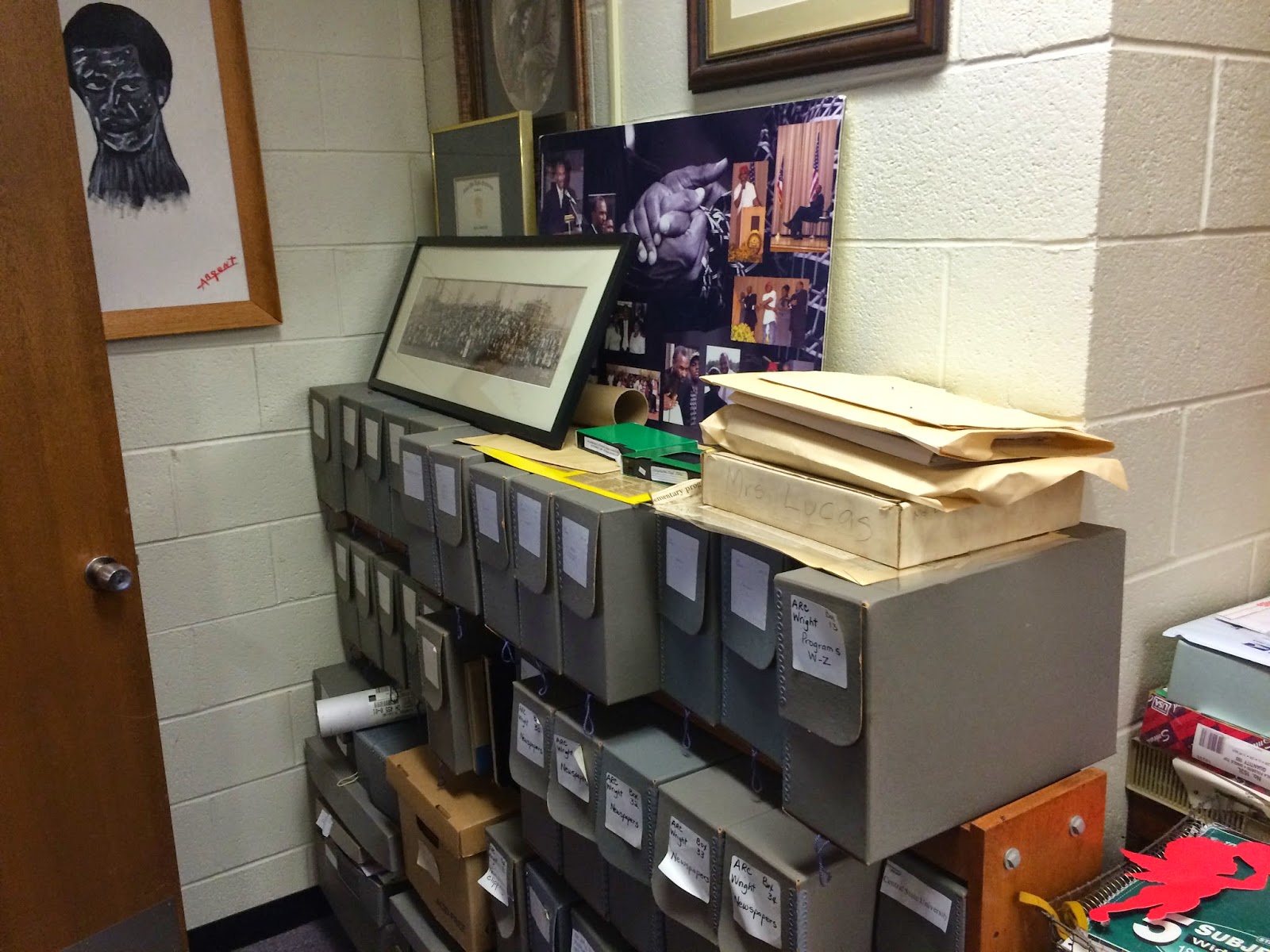
Being the first college to be owned and operated by African Americans, the archives contains an invaluable collection of materials related to the founding of the University, noted alumni, denominational and episcopal history, administration, African American History and student activity. Lining the walls when you first enter are busts, photographs, newspaper clippings and an assortment of artifacts ranging from the late 1800's to the present. Mrs. Brown showed us AME Conference Proceedings dating back to founding of the denomination and documents recounting the the start of Payne Theological Seminary. I will be working closely with Mrs. Brown to digitize some of Wilberforce's important papers and do a bit of processing. 

A little bit of history with me and Wilberforce. I applied to Wilberforce for undergrad back in 2003. Tuskegee University topped my list (I wanted to be a maroon jacket tour guide so bad!) with Wilberforce and Bethune-Cookman being the other two HBCU's to which I applied. Tuskegee offered me such a meager scholarship that my mother was easily able to dead my dreams with threats of being stranded in the middle of nowhere with thousands of dollars of loans (which she wouldn't co-sign) to pay off. Gotta love moms! I never received a letter of acceptance from Wilberforce. In mid December 2003 I received a Christmas card from them. A few weeks later, another Christmas card. No letter of acceptance ever reached my mailbox. Bethune-Cookman came through with the full ride and the rest is history.

I have found throughout my life that God has brought me back to the places I once desired strongly in his own time and to a better situation. I applied to Duke for seminary and did not attend but was brought back to work as the librarian there under wonderful leadership that shot my career to the stars. This is how I know God is real and moving, check out this piece history about the geographical location of Wilberforce:

"As a base for the college, the Cincinnati Conference bought a hotel, cottages and 54 acres (220,000 m2) of a resort property, named Tawawa Springs after a Shawnee word for "clear or golden water". European Americans had founded the health resort because of the springs, which historically the Native Americans had long used. Because of its location, the resort attracted summer people from both Cincinnati and the South. Some people in this area of abolitionist sentiment were shocked when wealthy Southern planters arrived at the resort with their entourages of enslaved or free African-American mistresses and mixed-race "natural" (illegitimate) children." James T. Campbell, Songs of Zion, New York: Oxford University Press, 1995, pp. 259–260.

Shawnee, Shanee' close enough not to be a coincidence for me ;) 


Archives Use Policy

I Didn't Get a Close Up but that poster includes photos from LL Cool J's Visit to Wilberforce

Wilberforce Yearbooks from Decades Past


Shot of Mrs. Brown, Dr. Fitchue (Payne President) and Myself